
Oklahoma DOC Release Coverage
The Oklahoma Department of Corrections operates a statewide system, not an Ottawa County jail. Its offender-information gateway can include people in a state institution, on probation or parole, in another active ODOC status, or shown as former or inactive. It does not index every person ever booked locally. Someone who bonded out on a county misdemeanor and never entered state corrections may have no ODOC record.
The opposite transition is equally important. An Ottawa County defendant sentenced to state imprisonment may leave the county roster when transported to ODOC. That departure is a transfer into state custody, not a community release. State intake and public-data updates may lag behind the sheriff's movement time. Search both systems when the county record or court judgment points to state imprisonment.
| ODOC result | Likely meaning | Next check |
|---|---|---|
| Institution or active facility | State custody is shown | Sentence and movement rows |
| Probation/parole office | Community supervision may be active | Exact status and local office |
| Inactive or discharged | Active ODOC status may have ended | Sentence lines, court, other holds |
| No result | No public match was found | Spelling, identifiers, county and VINE |
Search Oklahoma DOC Records
The official ODOC offender search begins with a disclaimer and reCAPTCHA. Basic Search fields are OK DOC number, first name, last name, and date of birth. Options allow alias data and similar-sounding names. DOC number is the best starting key when known because names can be shared, changed, or misspelled.
Use a deliberate search sequence and read every visible sentence row. An overall label may not describe each sentence in the same way.
- Enter the OK DOC number, or search the exact first and last name.
- Use date of birth and lawful physical or record identifiers to distinguish matches.
- Try alias or similar-sounding options only when the exact search fails.
- Open the record and review status, facility or supervising unit, movement, sentencing county, case number, and sentence data.
- Match an Ottawa County sentence to the court docket and county transfer record.
The service warns that its information is abbreviated and may be incomplete or inaccurate. Preserve the exact label and access date. Ask ODOC for documentation when a public result does not settle the status.
Oklahoma DOC Search Fields
The research identified both search inputs and public-data fields. A profile schema can include DOC number, name, last move date, facility, date of birth, physical descriptors, and status. Sentence data can include the sentence ID, statute, sentencing county, judgment date, criminal case number, incarceration term, and probation term. Public visibility can differ by record and interface.
| Field | Use in release verification |
|---|---|
| OK DOC number | Matches the correct state record |
| Status | Shows the system's current broad classification |
| Facility or office | Distinguishes prison from community supervision |
| Last move date | Provides a movement clue, not always final discharge |
| Sentencing county/case | Connects the record to Ottawa County court |
| Sentence rows | Shows that separate terms may have different histories |
An inactive profile with no facility supports that the person is not active in the current ODOC dataset. It is not an Ottawa County Jail release certificate. Combine it with sentence and movement data and the matching judicial record.
The official interface shows how the search begins. Open the ODOC source before entering a name or number.
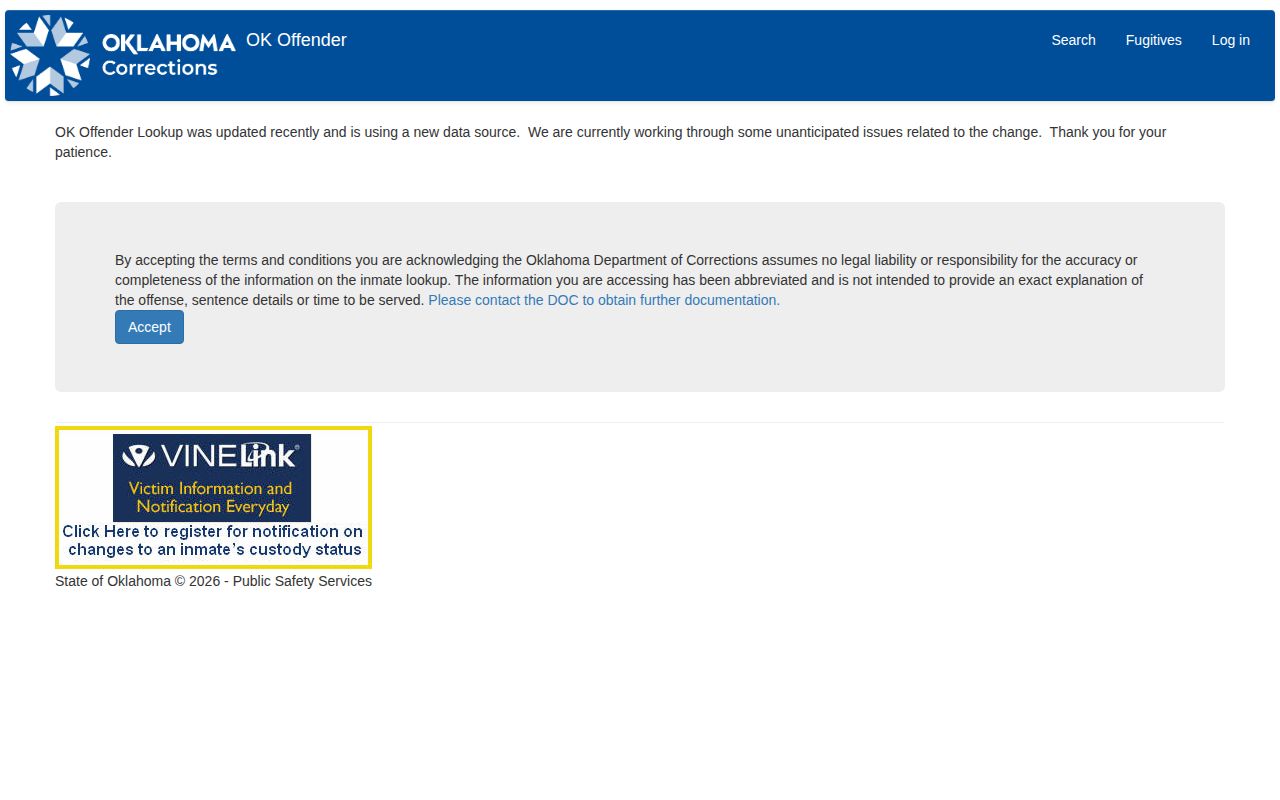
The captured form identifies the official inputs; the live result and ODOC documentation control the current status.
Oklahoma DOC Projected Release Dates
Oklahoma uses the term Projected Release Date, or PRD, for ODOC's estimate. It can rise or fall because of earned-credit class, achievement or program credits, misconduct, restored credits, sentence changes, aggregation, and new or cleared holds. The Pardon and Parole Board does not calculate PRD, and parole consideration is not physical release.
Public visibility is record-dependent. ODOC's current information says an exact inmate release date can be confidential without a legitimate need, while the ODOC policy library and other materials describe a projected date as a possible lookup field. Use the precise public label when it appears. Never reverse-engineer a withheld date, convert a credit schedule into a promise, or treat a projected day as the actual exit.
- Projected release date
- An ODOC estimate that can change.
- Earned credit
- A statutory credit that may reduce qualifying state-institution time.
- Parole
- Conditional community release after imprisonment.
- Discharge
- The recorded end of a sentence or supervision status, read across all cases.
County-jail sentences use their own judgments and calculations. ODOC's state credit framework should not be copied onto an Ottawa County jail term.
Oklahoma DOC Discharge Records
A state discharge record is tied to one or more sentences. It may contain reception, sentence start and end, parole, supervision, and discharge events. Read each sentence line. “Discharged” can mean an ODOC sentence or supervision term ended, but another sentence, warrant, detainer, or sovereign's custody may remain.
For a public document beyond the lookup, ODOC Legal Services offers an online Open Records Request form. Give the full name, DOC number, sentencing county, criminal case number, and exact status or discharge document sought. Public records remain subject to state and federal confidentiality rules. Nonpublic incarceration or supervision material may require a signed records release or another authorized process.
ODOC Sentence Administration / Closed RecordsStatewide system contact
405-425-2691
Discharge routing: osordischarges@doc.ok.gov
ODOC registry and discharge routing also lists 405-425-7601 and osor@doc.ok.gov. Those channels serve distinct records. A certified Ottawa County judgment or order still comes from the court clerk, not ODOC's public search.
Ottawa Transfers Into Oklahoma DOC
An Ottawa County Jail release sheet may say the person transferred to ODOC after sentencing. The county entry establishes the end of local custody and should carry a date, time, release type, or receiving authority. The ODOC reception record establishes entry into the state system. These are separate events and may not post at the same time.
Check the court judgment for state imprisonment and credit for time served. Then search ODOC by DOC number or name and compare sentencing county and case number. If the county says transfer but no ODOC result appears yet, allow for intake lag and verify with both custodians. Do not recast the county transfer as release to the community.
The Ottawa County released inmate search supplies the county roster, VINE, court, and records-request steps that lead into this statewide search. It also distinguishes a county discharge from an ODOC discharge.
Note: No Oklahoma Department of Corrections institution was verified within Ottawa County, so every ODOC facility reference here is statewide.
Oklahoma DOC Handoffs Need Follow-Up
Interagency handoffs matter at both ends of an ODOC record. Ottawa County booking data can identify outside holds, and a local disappearance may be an ODOC handoff. Later, ODOC can discharge its own sentence while another county, tribal, or federal authority still has lawful custody. One system's “released” or “inactive” label does not erase another system's case.
Follow the named receiver or active hold. BOP covers many sentenced federal prisoners and may later show a release date. The U.S. Marshals can hold federal defendants before BOP placement. ICE maintains a current detainee locator. Tribal and other-county cases require the responsible sovereign's records. Use the exact timeline rather than one broad “free” date.
A useful statement is narrow: “ODOC shows inactive as of the accessed record, while the Ottawa County case and any named receiver require separate confirmation.” That wording respects system boundaries and data lag.
Oklahoma DOC Status and Supervision
A person outside a prison may remain active under ODOC community supervision. A result tied to a probation or parole office is not complete discharge. Probation is a court-ordered status and can begin without state imprisonment. Parole follows release from confinement under conditions. Suspended sentences and post-imprisonment supervision have separate legal bases.
The Miami Probation and Parole Office covers Ottawa County, but the public offender record should be checked first. Staff may be limited in what they can disclose. The Oklahoma Pardon and Parole Board is separate from ODOC: it considers parole matters and publishes dockets and results, while ODOC administers supervision and sentence records. A favorable board action is not the actual prison exit.
Oklahoma VINE supplements custody checks but does not provide parole notification, according to the Board. Use ODOC and PPB for that path. A VINE silence or inactive notification should never replace the state record.
Read Every Oklahoma Sentence Row
An inactive ODOC profile does not always identify the exact discharge cause or date for each sentence. Match the DOC number, Ottawa sentencing county, criminal case number, judgment date, and every active or inactive sentence row. A facility field supports imprisonment, while a field-office entry supports community supervision. When the short public result cannot answer the question, request the narrow status or discharge document through ODOC records.